Buy or Build for Processing Your Documents
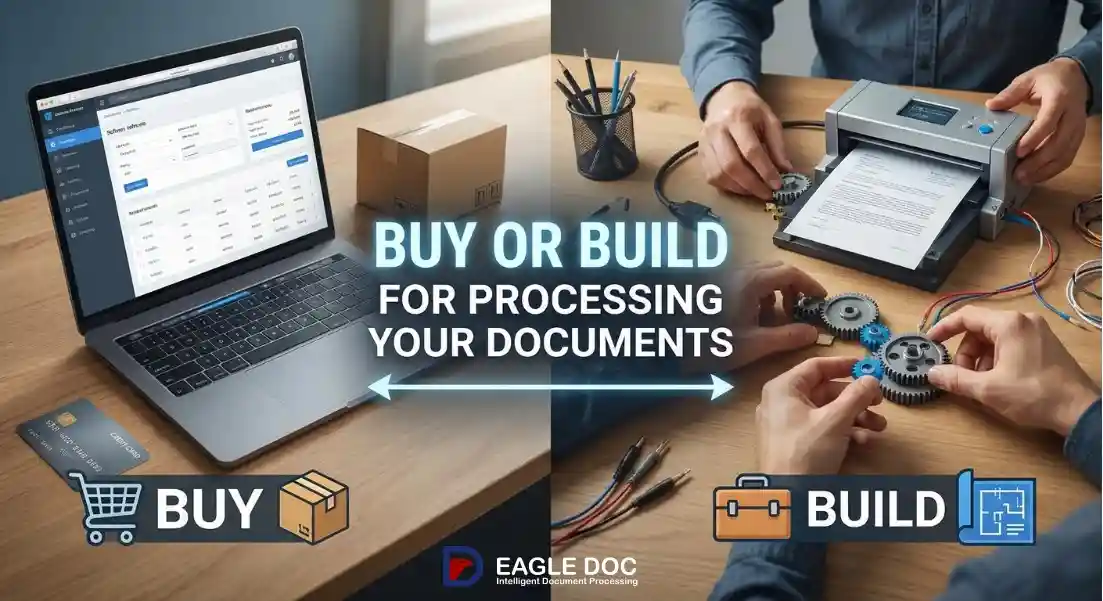
Whether you're handling invoices, receipts, contracts, or bank statements, document processing is no longer optional — it's core infrastructure. As businesses scale, manual document handling becomes expensive, slow, and error-prone. Automation is the answer. But one big question remains:
This article breaks down both paths, including cost, timeline, risk, and strategic outcomes, so you can choose what actually moves your business forward.
Document streams are exploding — accounting firms getting thousands of invoices weekly, fintechs onboarding customers with bank statements, logistics companies verifying delivery notes, and more.
Automation brings:
Because of this, every company eventually reaches the same crossroads: Buy or Build.
Many tech-forward companies consider building an internal OCR + AI pipeline. On paper, it sounds attractive: full control, customization, ownership of IP.
Building isn't just OCR. It usually requires:
| Component | Description |
|---|---|
| OCR engine | Text extraction from scanned PDFs/images |
| AI models (Machine Learning) | Line item parsing, PO number extraction, tax matching, labeling |
| AI models (LLMs) | Challenges include: • Context window size • Chunking long documents • Robust JSON parsing • Model availability (e.g., rapid retirement of Gemini/GPT models) |
| Data pipeline | Uploads, pre-processing, normalization |
| Validation workflows | Human-in-the-loop review, corrections |
| UI dashboards | For your finance or ops teams |
| Machine-learning ops | Retraining, monitoring, dataset management |
Internal build typically takes 6–18 months with:
→ And it never "finishes" — new formats, languages, tax rules, and layouts constantly emerge.
Buying means using an API or SaaS platform that already solves extraction, AI understanding, and workflows.
Instead of building infrastructure, teams integrate in hours and go live immediately.
| Benefit | Meaning |
|---|---|
| Speed | Go live in days, not months |
| Lower cost | SaaS fee instead of salaries + infrastructure |
| Accuracy | Vendor AI trained on millions of real docs |
| Maintenance-free | New formats auto-supported |
| Scale instantly | Handle 100 or 100k documents |
| Criteria | Build | Buy |
|---|---|---|
| Time to launch | 6–18 months | 1–3 days |
| Upfront cost | High | Low |
| Maintenance | Continuous work | Included |
| Accuracy | Starts low, grows slowly | High from day-one |
| Customization | Very high | Medium–high depending on vendor |
| Talent required | ML, backend, DevOps, QA | Integration engineer |
| Long-term ownership | Full | Dependent on vendor |
Ask yourself these 3 questions:
1️⃣ Is document processing a core product differentiator for me?
→ If yes → building may make sense.
2️⃣ Do I have time and engineering bandwidth to own a permanent in-house AI product?
→ If no → buying is smarter.
3️⃣ Do I need to deploy something quickly to serve customers?
→ Buying accelerates time-to-value.
Many companies start by buying first, automate quickly, prove ROI, then only build custom modules later — where it actually matters.
Think:
Buy = infrastructure
Build = specialized features unique to your market
Document processing feels like a simple problem — until you try to solve it. Successful companies stay focused: spend resources on what makes you different and outsource what doesn't.
If accelerating operations, scaling your business, and making customers happy is urgent, buying wins almost every time.
Get Started
Copyright © S2Tec GmbH